
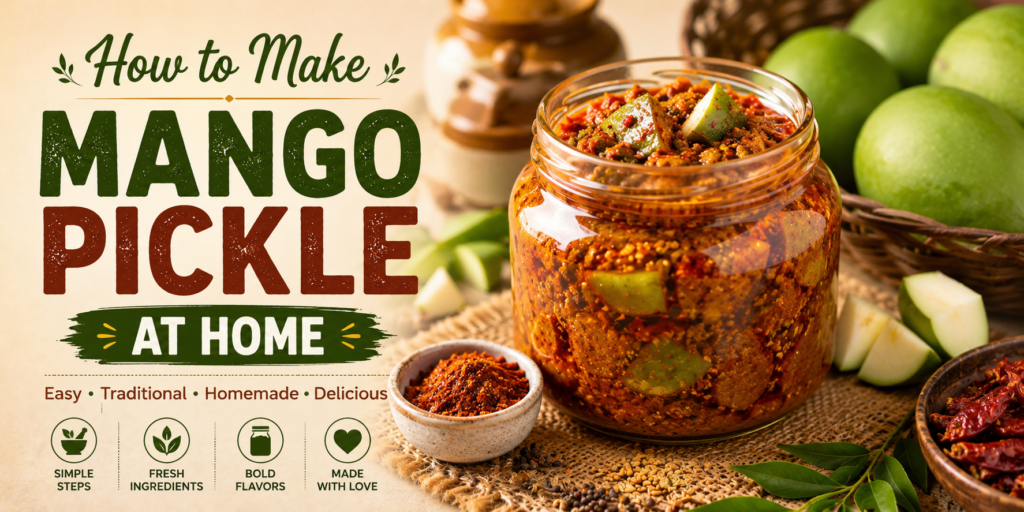
Few things come close to the exquisite taste of homemade mango pickle (Aam Ka Achar). Its sour, spicy, and flavorful characteristic has made it famous in Indian households for ages. Whether served with naan, lentils and rice, khichdi, or curd rice, mango pickle increases the taste of every meal.
The nice thing about it is that you do not need to be an expert chef to prepare it. By just having the fresh raw mango and good spices along with the technique, you can easily make it.
In this complete guide, you will learn how to make mango pickle at home with details on the ingredients needed, tips for long shelf life, and the common mistakes to avoid while preparing it.
Why Homemade Mango Pickle is Better
The preparation of mango pickle in the home offers several benefits including:
Being fresh without preservatives
Ability to control spiciness
Real homemade taste
Has the potential to last longer than market pickles if prepared well
Good price compared to market pickles
Being prepared with quality ingredients
Homemade pickle means you choose the best mustard oil and the freshest spices.
Ingredients Required
For about 2 kg of mango pickle:
Main Ingredients
2 kg unripe mangoes
250 ml of edible mustard oil
150 g of table salt
80 g of turmeric powder
100 g of red chili powder
120 g of coarsely-ground fennel seeds
100 g of crushed mustard seeds
50 g of fenugreek seeds
30 g of kalonji or nigella seeds
20 g of Hing
Step 1: Choose the Right Mangoes
The key to making a great pickle lies in selecting the right type of mango. Look for:
firm green mangoes that are raw
sour in nature
fresh skin without any wrinkled parts
absence of soft patches and fungal spots
stay away from ripe or semi-ripe mangoes since they will be too soft in storage.
Step 2: Wash and Dry Properly
Mangoes should be washed properly in order to eliminate dirt and pesticide residues. Once washed:
Make sure to dry them completely.
Keep them in an airy place such as a fan or sun for a few hours.
It’s very important to ensure that there is no moisture left on the fruit.
Even a tiny amount of water can decrease the shelf of the pickle.
Step 3: Cut the Mangoes
If desired, you can cut the mangoes into moderate-sized pieces without removing the tough inner skin.
Uniformity in size ensures that the spices are absorbed evenly throughout.
Remove any damaged or spoiled parts.
Step 4: Prepare the Spice Mix
Then mix:
Salt
Turmeric
Red pepper powder
Mustard seeds
Fennel seeds
Fenugreek seeds
Black cumin
Hing
This aromatic blend is the secret to traditional Indian mango pickle.
Step 5: Heat the Mustard Oil
Heat the mustard oil on the stove until it reaches the smoking point.
Then, let it cool slightly until moderately hot.
Heating the oil removes the pungent taste of mustard oil and enhances its flavor.
Step 6: Mix Everything Together
In a large bowl:
Add chopped mangoes.
then mixture of spices.
and finally Add the hot mustard oil.
Mix/mingle to make sure that all of the mangoes are covered with spices.
Step 7: Store in a Clean Glass Jar
Move the chutney to a clean glass jar.
Gently tap the chutney.
Check if the oil can cover the mango pieces adequately.
Ensure that the lid is closed well.
The sun should help in the curing of chutney.
Place the jar in the sun.
Shake or stir the jar regularly.
During this period,
the mango pieces will get softened,
the masala will get absorbed,
and the oil will develop flavor.
If you want your chutney to last for months,
always use dry utensils.
Make sure there is no water inside the jar.
Store in a dry place.
Always ensure that the oil remains above the chutney.
Use fresh spices.
Only use quality mustard oil.
Close the lid properly after every use.
Common Mistakes to Avoid
The use of Wet Mangoes
The moisture acts as a catalyst for mould growth.
The use of Low-Quality Oil
Low-quality oil can spoil the taste and preservation.
Not enough use of Salt
Salt is a natural preservative.
Not exposing the fruit to sunlight
Sun drying enhances taste and preservation.
The use of Plastic Pans
Glass jars are more secure and taste preserving.
Health Benefits of Mango Pickle
The consumption of mango pickle in moderation has several advantages:
High in antioxidants from spices
Helps digest food due to mustard and fennel
Contains useful natural oils
Sours simple meals
Improves appetite
Since the pickle has salt and oil in the recipe, moderation is advisable.
Some Ideas for a Serving
Homemade mango pickle is most delicious with:
Stuffed parathas
Normal parathas
Dal rice
Khichdi
Poori
Thepla
Curd rice
Bajra roti
Chapati
How to Store Mango Pickle
Achieving maximum freshness is dependent on correct storage methods.
The jar should be stored:
Away from moisture
Away from water and dampness
At room temperature
In a clean dry kitchen cupboard
It is advisable to use a dry spoon while serving.
Summary
How to make mango achar is something that is easier than what most people think. Using raw mangoes, spice, mustard oil, and correct storage, it is possible to have good mango achar that can be enjoyed for months.
Making mango achar offers the additional benefit of users being able to control what goes into their mango achar and how much spice they want.
Frequently Asked Questions (FAQs)
1. Which mango is better for preparing mango pickle?
Firm, immature, sour green mangoes are the best as they keep their shape.
2. How long can homemade mango pickles be stored?
If the mango pickle is stored properly in a clean bottle of glass with enough mustard oil, it can be stored for up to 6 to 12 months.
3. Why do we need mustard oil for making mango pickle?
Mustard oil serves as a natural preservative and gives the very special flavor that is very needed for traditional mango pickle in India.
4. Is it possible to prepare mango pickles without sunlight?
Yes, you can do it, but sun exposure helps the mango pickle to have better flavor and texture and improves the preservation quality of the pickle. In case no sunlight is available, the process of mango pickle preparation will take longer.
5. Why has my mango pickle become bad?
Common reasons for that include presence of moisture in the jar, wet mangoes, insufficient salt, low level of oil in the jar, or using wet spoon for taking the mango pickle out of the jar.