Introduction
For years now, Desi Cow Ghee has been part and parcel of Indian cooking. Whether used on top of hot rotis or as part of the preparation of dal, khichdi, halwa and even sweet dishes, cow ghee is popular because of its unique aroma and flavor.
In recent times, the interest of people in traditional foods has increased and searches for pure desi cow ghee, cow ghee online and traditional cow ghee keep on rising. However, with so many types of cow ghee being available in the market, one vital question arises: how can you get good quality ghee, and what do you expect from it?
This article gives an insight into Desi Cow Ghee, the process of making it, its nutritional values, the way it is used in cooking, how to store it, and lastly what to look out for when buying Desi Cow Ghee online.
What Is Desi Cow Ghee?
Desi Cow Ghee is a purified form of milk fat that is derived from cow’s milk or cow’s milk butter. In its production process, water is eliminated, and milk solids are separated from the fat.
The end product usually takes on the golden-yellow color, although there may be variations in color due to the diet of the cow or the production process.
Good cow ghee is particularly appreciated for its:
- Rich aroma
- Smooth texture
- Traditional flavour
- Versatility in Indian cooking
- Relatively concentrated fat content
- Long history in Indian food culture
Ghee is not the same thing as regular butter. The reason is that butter has both water and milk solids, whereas ghee is mostly milk fat.
Why Is Desi Cow Ghee So Popular in India?
Use of ghee is as old as the Indian cuisine tradition.
In the absence of the modern day processed fats and oils, people traditionally made ghee at home using milk, curd, cream or butter.
Even till date, nothing like a mouthful of roti or dal with warm ghee can bring home the sense of traditional Indian home cooking.
Desi Cow Ghee is used with:
- Roti & Paratha: A little bit of warm ghee enhances the flavor and gives aroma.
- Dal: Ghee is used for tadka of cumin, hing, chili and many more.
- Khichdi: Warm khichdi with a little ghee makes a good combination.
- Traditional Sweets: Halwa, ladoo and many mithai recipes.
- Rice: Little bit of ghee gives flavor to rice and pulao.
Versatility in both sweet and savory dishes is one of the biggest reasons behind its popularity.
How Is Traditional Cow Ghee Made?
There are various ways of producing cow ghee, and consumers get confused by the names of these different processes.
In one method, milk can be made to form curd which is then churned to separate butter. Butter is slowly melted to remove water and milk solids.
This is then filtered to form ghee.
There is another method where ghee is prepared from butter, which is slowly melted.
The process determines the flavor, aroma, and cost of the ghee.
What Is Bilona Cow Ghee?
You might have come across advertisements for Bilona Ghee or Traditional Bilona Cow Ghee.
The term usually means a traditional method of making, where curd is churned to extract butter, which is then made to form ghee.
Since there are more steps involved in its manufacture than just clarifying commercial butter, Bilona-style ghee is often marketed as a premium ghee.
It must be remembered, though, that Bilona in itself does not guarantee anything in terms of quality.
Desi Cow Ghee Nutrition
The main use of ghee is that it is a source of dietary fat and is energy-rich.
It consists of various kinds of fatty acids like saturated and unsaturated fats. Fat-soluble vitamins can also be present in ghee in minute amounts, although it varies according to the source from which it comes.
Since ghee is rich in fat content, it is essential to be careful about the amount consumed.
Although a spoonful does not sound much, fats yield many more calories per gram than carbohydrates and proteins.
It is not necessary that everyone should avoid ghee.
Potential Benefits of Desi Cow Ghee
Many exaggerated health claims about ghee circulate online, so it’s useful to separate its genuine food qualities from marketing claims.
1. Provides Dietary Fat
Fat is an essential macronutrient involved in several normal bodily functions. Ghee can contribute dietary fat as part of an overall balanced diet.
2. Adds Flavour with a Small Quantity
Because ghee has a distinctive aroma and rich taste, a relatively small quantity can substantially improve the flavour of foods such as dal, roti and khichdi.
3. Useful for Cooking
Ghee is widely used for sautéing, tadka and numerous traditional recipes.
4. Works with Fat-Soluble Nutrients
Dietary fat helps the body absorb fat-soluble vitamins from food. This is a general property of dietary fats rather than a unique medicinal effect of ghee.
5. Fits Traditional Indian Cuisine
One of ghee’s greatest strengths is culinary rather than medicinal. It works naturally with Indian spices, grains, pulses, vegetables and sweets.
Is Desi Cow Ghee Healthy?
It will depend largely on the amount you eat and your other eating habits.
Ghee is high in calories and saturated fat. Thus, eating a lot just because it is described as “natural” or “traditional” doesn’t make sense.
For many people, some amount may be added to their balanced diet.
Your eating habits will be more important than regarding one food product as miraculous or a complete taboo.
For those who have certain health problems or have been prescribed a special diet, consulting a medical specialist will be required.
Cow Ghee vs Buffalo Ghee
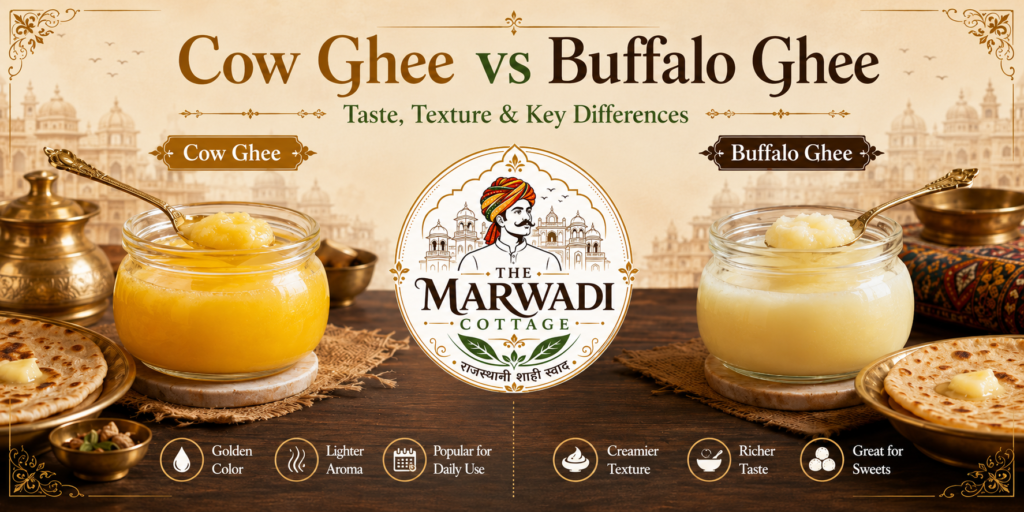
Both cow and buffalo milk can be used to prepare ghee, but consumers may notice differences.
| Desi Cow Ghee | Buffalo Ghee |
| Made from cow milk | Made from buffalo milk |
| Often yellowish/golden | Often comparatively pale |
| Distinctive aroma | Different flavour profile |
| Popular for everyday cooking | Also widely used in Indian cuisine |
| Texture varies by preparation | Can have a different consistency |
Neither colour alone nor texture alone proves purity. Natural variation can occur, so quality should be assessed using reliable product information rather than appearance alone.
Desi Cow Ghee vs Butter
Ghee and butter are related but not identical.
Butter contains milk fat along with water and milk solids.
During ghee preparation, the butter is heated so that water evaporates and milk solids separate. The clarified fat is then filtered.
This gives ghee its characteristic concentrated flavour and different cooking properties.
Ghee is therefore commonly preferred for traditional Indian tadka and recipes where its distinctive aroma is desirable.
How to Use Desi Cow Ghee
Cow ghee is one of the most versatile ingredients in an Indian kitchen.
On Roti
Spread a small amount over freshly prepared roti.
With Dal
Prepare a traditional tadka using ghee, cumin, hing, garlic or chilli according to your recipe.
With Khichdi
Add a small spoonful before serving.
With Rice
Mix ghee with hot rice and dal for a simple traditional meal.
For Paratha
Ghee can be used according to the preparation style and desired flavour.
In Sweets
Use it in traditional recipes such as:
- Besan ladoo
- Atta halwa
- Suji halwa
- Panjiri
- Moong dal halwa
- Various traditional mithai
For Festive Cooking
Ghee is also widely used in foods prepared during Indian festivals and celebrations.
How to Identify Good-Quality Desi Cow Ghee
People frequently search for information on how to test “pure cow ghee,” yet there are many home tests available through the internet that do not provide enough certainty.
It would be more useful to analyze the product in advance.
Check the Ingredient List
The ingredients should clearly identify the source used to make the ghee.
Read the Food Label
Check nutrition information, manufacturer details, net quantity and required regulatory information.
Check the Packaging
The container should be properly sealed and undamaged.
Check the Aroma and Taste
Good ghee generally has a characteristic pleasant aroma, although flavour naturally differs between preparation methods.
Avoid Unrealistic Claims
Watch out for sellers that claim ghee can cure diseases or help lose weight instantly, among others.
It is not necessary to make such grand health claims for quality food.
How to Buy Desi Cow Ghee Online
If you’re planning to buy cow ghee online, compare products beyond price.
Look for:
- Clear ingredient information
- Transparent milk source information where available
- Preparation method
- Proper food labelling
- Manufacturing and best-before information
- Secure packaging
- Storage instructions
- Seller/manufacturer information
Also compare the price per kilogram or litre-equivalent quantity rather than simply comparing jar prices, since pack sizes vary considerably.
How to Store Desi Cow Ghee
The proper method of storage will ensure that the aroma and taste of ghee are preserved.
The ghee must always be kept tightly covered as per the instructions on the packaging.
One must always use a very clean and dry spoon. The addition of any kind of moisture or food particles will result in the spoilage of the ghee.
Ensure that the jar is not exposed to too much heat and sunlight unless the instruction label says so.
Texture changes with temperature fluctuations is natural. Ghee becomes hard with cold and soft with heat.
Why Choose The Marwadi Cottage Desi Cow Ghee?
Indian traditional foods aren’t only limited to recipes; they also include ingredients that have been used by multiple generations of families at home.
At The Marwadi Cottage, we believe in maintaining the homely feel of traditional foods.
Our concept of Desi Cow Ghee revolves around what customers can look for in a traditional food product—quality, taste, clear labeling, and proper preparation.
Whether it is a matter of adding ghee to roti, cooking dal tadka, khichdi, or traditional desserts, the idea remains the same: bring back the taste of India in your meal.
“जो हम खाते हैं वही आपको खिलाते हैं।”
Desi Cow Ghee in Traditional Rajasthani Food
Ghee has a very special significance in Rajasthani food.
Consider the example of classic foods like Dal Baati Churma.
It is the ghee that plays a major role in lending to this dish its distinctive rich taste and flavor.
Ghee also forms an integral part of many rotis, halwa, churma, and celebration foods.
This makes the use of ghee in the context of branding the product along with other traditional Rajasthani foods like achar, chutney, papad and namkeen quite natural.
Conclusion
“Desi Cow Ghee” continues to be one of the best-known traditional kitchen ingredients in India.
The fragrance, taste, and versatility of this oil are such that it can be used for cooking simple everyday dishes like dal and roti as well as for dishes like khichdi, paratha, and even Indian sweets.
However, the quality is what counts.
As far as cow ghee is concerned, instead of going after products which make big claims about the health benefits of the product, go for the quality of the product.
If you are looking for Desi Cow Ghee, cow ghee, traditional cow ghee, or simply Indian ghee, concentrate on quality rather than marketing gimmicks.
FAQs
1. What is Desi Cow Ghee?
Desi Cow Ghee is clarified milk fat prepared from cow-milk-derived ingredients such as butter. The clarification process removes most water and separates milk solids from the fat.
2. Is Desi Cow Ghee good for daily use?
Ghee can be included in a balanced diet, but it is energy-dense and contains substantial saturated fat. Appropriate quantity depends on an individual’s overall diet and nutritional needs.
3. What is the difference between cow ghee and Bilona ghee?
Cow ghee describes ghee made from cow milk, whereas Bilona generally refers to a traditional preparation process involving curd churning and butter separation before clarification. A cow ghee product may therefore also be Bilona-style if prepared using that process.
4. Can Desi Cow Ghee be used for cooking?
Yes. Ghee is commonly used in Indian cooking for tadka, sautéing, rotis, parathas, rice dishes and traditional sweets.
5. How should I store cow ghee?
Keep it properly sealed, use a clean and dry spoon, protect it from contamination and follow the storage and best-before instructions on the product label.