Introduction
From a spoonful over hot dal to the rich aroma of freshly prepared halwa, Desi Cow Ghee has been part of Indian kitchens for generations. In recent years, however, another term has become increasingly visible on premium dairy products: A2 Desi Cow Ghee.
Consumers searching for traditional and minimally processed foods often encounter products labelled A2 Cow Ghee, A2 Bilona Ghee, Pure A2 Desi Ghee, or A2 Ghee from Desi Cows. But what exactly does “A2” mean? Is A2 ghee fundamentally different from regular cow ghee? And what should you check before paying a premium price?
This guide explains A2 Desi Cow Ghee, its traditional preparation, nutritional characteristics, culinary uses, storage and buying considerations—without relying on exaggerated health claims.
What Is A2 Desi Cow Ghee?
What is A2 Desi Cow Ghee?
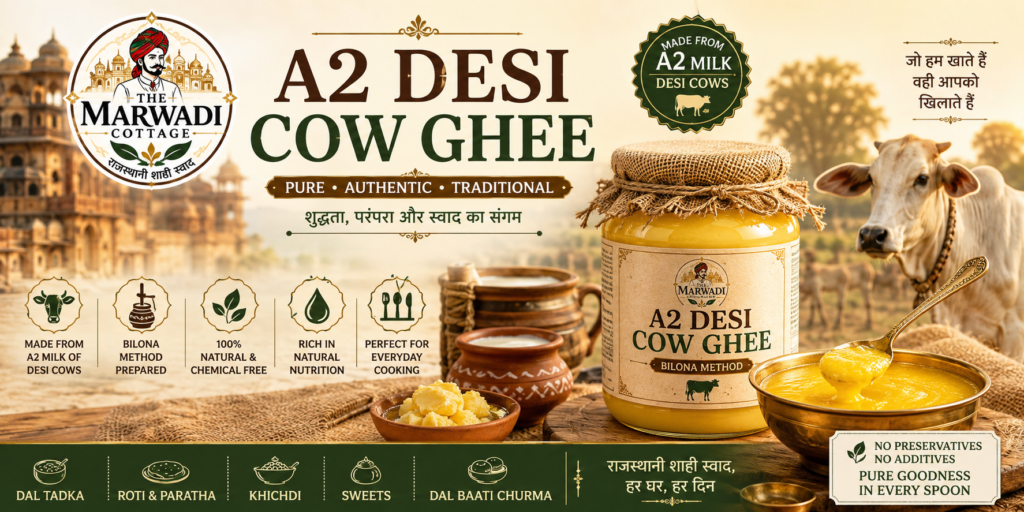
Desi Cow A2 ghee is a type of cow ghee that comes from milk from cows that have the A2 variety of beta-casein protein, which is a milk protein.
Beta-casein protein is a natural component of cow’s milk. A1 and A2 describe various forms of this protein.
There is something that must be clarified: ghee is largely fat of milk. In the course of the correct clarification procedure, most of the water and milk solids (with a majority of proteins) are separated out.
So, the A2 label more describes the milk from which the ghee was made rather than being a high protein A2 product.
What Makes A2 Desi Cow Ghee Popular?
A2 ghee has gained much popularity among people who have interest in Indian cuisine.
There are several reasons behind the popularity of A2 ghee.
Interest in Traditional Food
There are many A2 ghee products which highlight traditional Indian cows and the tradition of Indian milk.
Interest in Traceability of the Food Ingredients
People nowadays have an interest in knowing about the sources of their food items.
Traditional Bilona Process
Traditional premium A2 ghee is always made using the Bilona process although both terms have different meanings.
Indian Cuisine
Whatever the quality may be, cow ghee is very important for dal, roti, khichdi, paratha and for many other Indian cuisines.
What Is A2 Bilona Cow Ghee?
You will commonly notice the use of A2 Desi Cow Ghee and A2 Bilona Ghee together, but each of these two terms represents a different attribute.
A2 stands for the milk ingredient along with its beta-casein type.
Bilona stands for a traditional preparation process.
The traditional Bilona preparation involves culturing of the milk into curd, followed by churning the curd to form butter. Finally, this butter is heated slowly to clarify ghee.
Hence:
A2 + Bilona = A2 milk ingredient + Bilona preparation process.
It is possible for ghee to be produced from A2 milk without the Bilona method, therefore one needs to confirm the two independently.
How Is Traditional A2 Desi Cow Ghee Made?
While the procedure may vary for different manufacturers, below are the steps followed using the Bilona process.
1. Collection of Milk
Collecting milk from the cows which the manufacturer uses.
In the case where a product is advertised as A2 Cow Ghee, the manufacturer should be able to justify the use of A2 source of milk.
2. Curd Preparation
Curd is prepared from the milk using the production process.
3. Churning
Curd is churned to extract butter.
Churning in this case is linked to the word ‘Bilona.’
4. Separation of Butter
Butter is extracted after churning of the curd.
5. Slow Heating
Heating of the butter is done in order to evaporate water and allow separation of milk solids and fat.
6. Filtering
Clarified ghee is filtered before being packed.
This procedure helps to give the characteristic flavor, texture and aroma of ghee.
A2 Desi Cow Ghee Nutrition
A2 Desi Cow Ghee is, after all, ghee and hence its primary nutritional constituent remains fat.
It is calorie-rich and consists of fatty acids in various forms, including saturated fat.
The presence of fat-soluble constituents of ghee varies from one batch to another depending upon the source of milk and processing used.
Nonetheless, it should never be confused with being a protein-rich food merely based on the classification of milk as A2.
The reason behind this lies in the fact that the categorization of milk into A1 and A2 is done based on the protein beta-casein.
Potential Benefits of A2 Desi Cow Ghee
Online articles usually use very sensational statements while writing on the topic of A2 ghee. It would be appropriate to highlight more realistic features while marketing such product.
1. Source of Dietary Fat
Ghee is rich in dietary fat, which is an essential macronutrient necessary for the body.
Nevertheless, since dietary fat is energy-dense, the quantity should not be neglected.
2. Makes the Food More Delicious
Just a little bit of high-quality ghee will make the food much more delicious.
It is especially effective for adding some taste to dishes like dal, rice, khichdi and roti.
3. Useful for Different Types of Cooking
Ghee of A2 cows can be used for:
Tadka
Sautéing
Indian desserts
Roti and paratha
Rice dishes
Tradition Indian cooking
4. Suitable for Traditional Indian Cuisine
Ghee is a well-established product in the Indian food culture.
Therefore, people who value traditional foods will prefer it to some other products.
5. Effective With Fat-Soluble Vitamins
Fat-soluble vitamins are absorbed together with dietary fats from the food.
Is A2 Cow Ghee Better Than Regular Cow Ghee?
Articles that have been published online tend to claim a lot about the A2 ghee. In any case, it would be wise to emphasize realistic qualities for food marketing purposes.
1. Source of Dietary Fats
The ghee is a source of dietary fats which are necessary for the proper functioning of the human body.
Nonetheless, since it is energy-rich, it is important to consider the amount of its use.
2. Flavoring Agent
It is a good addition to foods when you need to provide them with flavor.
Especially suitable when used with dal, rice, khichdi, and roti.
3. Cooking Ingredient
Among other things, the A2 cow ghee can be used for the following purposes:
Tadka
Sauteing
Indian sweets
Roti and paratha
Rice preparations
Traditional dishes
4. Ingredient Suitable for Traditional Indian Cuisine
The ghee has been traditionally used as an ingredient in the Indian food culture.
Consequently, people who are looking for more traditional ingredients would prefer it to some very processed cooking fats.
5. Good Source for Combining with Fat-Soluble Vitamins
Fats present in the ghee assist with the absorption of fat-soluble vitamins from the foods consumed.
A2 Ghee vs Regular Cow Ghee
| A2 Desi Cow Ghee | Regular Cow Ghee |
| Marketed as originating from A2 milk | May originate from different cow milk sources |
| Often associated with indigenous breeds | Breed/source varies |
| Frequently sold as a premium product | Available across price ranges |
| May use Bilona preparation | Preparation method varies |
| Usually marketed around traceability | Traceability depends on producer |
The nutritional differences in the finished ghee should not be exaggerated without product-specific evidence.
A2 Ghee vs A2 Milk
The above products should not be confused.
A2 milk contains water, proteins, carbohydrates, fats, vitamins and minerals.
A2 ghee, after the clarification process, has primarily milk fat as its component.
Thus, despite the fact that A2 ghee is derived from A2 milk, its composition differs radically from the original one.
It is especially true when you encounter health claims on the Internet.
Is A2 Desi Cow Ghee Good for Daily Use?
Ghee can also be used in cooking regularly; however, the quantity needs to be determined according to your diet.
The A2 version of ghee is still high in calories and saturated fat.
Using too much ghee when you have an abundant diet just because the ghee is labeled A2 or traditional does not make sense.
Instead, you may consider using it mainly to enjoy its taste and use in cooking.
However, individuals who have certain dietary restrictions need to consult their health practitioners.
Best Ways to Use A2 Desi Cow Ghee
One advantage of ghee is that it works across a wide variety of Indian dishes.
Dal Tadka
Heat a small amount of ghee and add cumin, hing, garlic or chilli according to your recipe.
Roti
Spread a small quantity over freshly prepared roti.
Khichdi
Warm ghee complements the mild flavours of dal and rice beautifully.
Paratha
Use ghee according to your preferred cooking method.
Rice
A little ghee can add aroma and richness to hot rice or pulao.
Dal Baati Churma
Ghee plays an especially important culinary role in this famous Rajasthani dish.
Traditional Sweets
A2 Desi Cow Ghee can also be used for recipes such as:
- Besan ladoo
- Atta halwa
- Suji halwa
- Panjiri
- Moong dal halwa
- Churma
How to Choose Pure A2 Desi Cow Ghee
If buying online, do not just go with the traditional labeling on the front of any A2 Desi Cow Ghee pack that you intend to purchase.
Ingredient List Verification
Ensure that you know the ingredients used in the making of the ghee.
Verify the A2 Claim
In case being an A2 is significant for you, then ensure that the producer does have any meaningful information in this regard.
Determine whether it is really Bilona Ghee
“A2” does not mean that it is Bilona ghee. If you particularly intend to buy Bilona ghee, then verify this separately.
Check Food Labeling
There should be all the information like producer details, nutritional details, quantity, manufacturing/best before and others legally required on foods.
Packaging Verification
The pack itself should be sealed, without any form of leakage or damage.
Do Not Be Fooled by Miraculous Health Claims
Some health claims made about some specific ghee curing diseases, ensuring weight loss and body detoxification or other amazing effects may need caution.
How to Identify Pure A2 Cow Ghee
You will encounter many viral “purity tests” on refrigerating, heating, color, or texture.
The above tests done at home cannot definitively detect every type of adulteration and check if milk was obtained from A2 cows.
Color, too, is not always the deciding factor.
Ghee can have different properties depending on factors like the type of milk, diet, seasons, and manufacture process.
For those who care about authenticity, the right sourcing, proper testing, and information on manufacturing are far more important than kitchen tests that go viral on the internet.
How to Store A2 Desi Cow Ghee
Proper storing will help retain the flavor and quality of ghee.
Make sure that the packaging is tightly closed and that you always use a clean and dry spoon.
Do not expose the jar to any water or food particles.
Follow the guidelines of the manufacturer and make sure it is stored in places which do not have any unnecessary warmth and sunlight.
Ghee may harden due to cold weather and soften due to hot weather. This does not mean that there is something wrong with the quality of ghee.
Always check the best before date on the packing.
Why Choose The Marwadi Cottage A2 Desi Cow Ghee?
The Marwadi Cottage’s food concept is rooted in traditional kitchens in Rajasthan, where taste, ingredients, and preparation have always been valued.
The idea is to introduce traditional food to modern families without losing the characteristic elements of home-cooked Indian food.
In choosing A2 Desi Cow Ghee, the customer can be assured of knowing the provenance and preparation of the product without being lured into false advertising.
Quality ghee will give an additional flavor to meals such as fresh rotis, dal tadka, khichdi, and traditional Rajasthani dishes.
Our philosophy remains:
“जो हम खाते हैं वही आपको खिलाते हैं।”
And our identity celebrates:
“राजस्थानी शाही स्वाद।”
Why A2 Desi Cow Ghee Fits Rajasthani Cuisine
There is a lot of connection between Rajasthan and the cooking ingredient, Ghee.
The most notable one could be Dal Baati Churma, which uses the ghee in making the dish very delicious and rich in flavor.
Ghee is also used in many other dishes including traditional sweets, rotis, and churma among others.
Anyone looking forward to enjoying the true flavor of Rajasthani cuisine would find ghee to be as natural as achar, chutney, papad, and namkeen.
Conclusion
A2 Desi Cow Ghee brings together the traditional flavor of ghee along with the contemporary trend of traceable milk products and heritage cooking techniques.
However, when choosing A2 Desi Cow Ghee, one must not forget the vocabulary involved.
While A2 refers to the source of milk, Bilona is a description of a process. Either does not necessarily indicate quality on its own.
Transparency, ingredient list, proper labeling, hygiene in production and authentic packaging are what matter.
Properly used, A2 Desi Cow Ghee can provide the characteristic smell and taste of traditional Indian cooking in roti, dal, khichdi, paratha, Dal Baati Churma and Indian sweets.
FAQs
1. What is A2 Desi Cow Ghee?
A2 Desi Cow Ghee generally refers to ghee produced from milk sourced from cows associated with the A2 variant of beta-casein. Ghee itself consists predominantly of milk fat because most milk proteins are removed during clarification.
2. Is A2 ghee the same as Bilona ghee?
No. A2 refers to the milk source, whereas Bilona refers to a traditional preparation process. A product can be marketed as both if it satisfies both descriptions.
3. Is A2 Desi Cow Ghee healthier than normal ghee?
A2 ghee is often marketed as a premium product, but claims of major health superiority in finished ghee should be treated carefully because ghee contains very little milk protein. Overall quality, quantity consumed and the rest of your diet remain important.
4. Can A2 Cow Ghee be used every day?
It can be incorporated into everyday meals in appropriate quantities. However, ghee is energy-dense and contains substantial saturated fat, so consumption should fit within your overall dietary needs.
5. How can I choose pure A2 Desi Cow Ghee online?
Check the ingredient list, A2 sourcing information, preparation method, food-label declarations, manufacturer details, packaging and storage instructions. Avoid relying solely on terms such as “A2,” “pure,” or “traditional.”