Introduction
Rajasthan is famous not only for its royal heritage and colourful culture but also for foods created from ingredients uniquely adapted to the desert. Among these traditional delicacies, Ker Sangri Pickle holds a special place.
Made from ker and sangri, two ingredients closely associated with Rajasthan’s arid landscape, this pickle delivers a distinctive combination of tangy, spicy, earthy and savoury flavours. Traditional Indian spices and oil transform these desert ingredients into an achar that pairs beautifully with roti, paratha, dal chawal and many other everyday meals.
For anyone searching for Ker Sangri Pickle, Rajasthani Ker Sangri Achar, homemade Ker Sangri pickle, or authentic Rajasthani pickle online, understanding its ingredients and preparation makes this regional speciality even more interesting.
At The Marwadi Cottage our focus is on bringing traditional Rajasthani flavours to modern households while preserving their familiar homemade character.
What Is Ker Sangri Pickle?
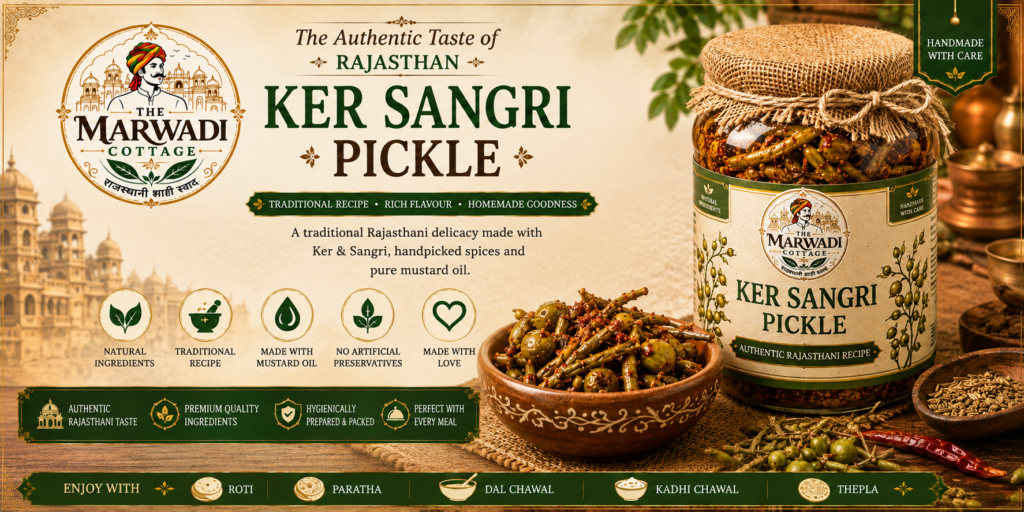
Ker Sangri Pickle is a traditional Rajasthani achar prepared primarily from ker and sangri along with spices, salt and oil.
Ker
It has a distinctive tangy character and is commonly used in pickles and regional dishes.
Sangri
Sangri consists of the slender pods of the khejri tree (Prosopis cineraria), a tree strongly associated with Rajasthan’s desert ecosystem.
When combined, these two ingredients create the famous Ker Sangri combination found in Rajasthani cuisine.
While many people know Ker Sangri as a sabzi, it can also be transformed into a flavourful pickle that can be stored and served conveniently alongside meals.
Why Is Ker Sangri Famous in Rajasthan?
Ker and sangri became important ingredients in Rajasthan partly because they are associated with vegetation that can survive the state’s dry conditions.
Traditional Rajasthani cuisine developed around ingredients that could cope with limited water availability and harsh climatic conditions.
Over generations, cooks developed ways to prepare these ingredients using spices, drying, soaking, cooking and pickling techniques.
Today, Ker Sangri has become much more than a practical desert food. It represents an important part of Rajasthani culinary heritage.
For visitors to Rajasthan, dishes prepared with Ker Sangri are often among the regional foods they want to experience.
What Does Ker Sangri Pickle Taste Like?
Ker Sangri Achar has a flavour profile quite different from common mango or lemon pickle.
You can generally expect a combination of:
Tangy + Spicy + Salty + Earthy + Aromatic
Ker contributes its characteristic sharp and tangy flavour, while sangri provides a distinctive earthy texture.
Traditional spices add warmth and complexity.
Depending on the recipe, commonly used spices may include:
- Mustard seeds
- Fennel seeds
- Fenugreek
- Red chilli
- Turmeric
- Coriander
- Hing
- Salt
- Other traditional pickle masalas
The exact spice blend can vary between households and regions.
Traditional Ingredients Used in Ker Sangri Pickle
A traditional-style recipe may include:
Ker and Sangri
These are the defining ingredients and form the base of the pickle.
Mustard Oil
Mustard oil is traditionally used in many North Indian pickles because of its strong, distinctive flavour.
Red Chilli
Adds heat and colour.
Turmeric
Provides an earthy flavour and characteristic colour.
Mustard Seeds
Mustard complements the flavour of both ker and sangri.
Fennel
Fennel can add a mildly sweet and aromatic note.
Fenugreek
Used carefully, fenugreek provides another layer of traditional pickle flavour.
Hing
A small quantity can contribute a strong savoury aroma.
Recipes vary considerably, so consumers should check the ingredient list of the specific product they purchase.
How Is Ker Sangri Pickle Traditionally Prepared?
Preparing Ker Sangri requires attention because dried or raw ingredients usually need to be properly cleaned and prepared before pickling.
A typical process involves several stages.
1. Cleaning the Ker and Sangri
The ingredients are carefully sorted to remove unwanted particles.
2. Soaking
Depending on the ingredients and recipe, ker and sangri may be soaked before further preparation.
This helps prepare their texture and flavour.
3. Cooking or Blanching
Some recipes boil or blanch the ingredients before pickling.
4. Drying
Excess moisture is removed because moisture management is particularly important when preparing foods intended for longer storage.
5. Preparing the Masala
Traditional spices are measured and combined according to the desired flavour.
6. Mixing with Oil
The prepared Ker Sangri is combined with spices and oil.
7. Resting the Pickle
The mixture is allowed time for the spices and ingredients to develop their characteristic flavour.
The exact preparation process differs according to family recipes and commercial production methods.
Ker Sangri Pickle vs Ker Sangri Sabzi
Although both use the same core ingredients, they are quite different.
| Ker Sangri Pickle | Ker Sangri Sabzi |
|---|---|
| Served as a condiment | Served as a main/side dish |
| Strong, concentrated flavour | More balanced cooked flavour |
| Usually spicy and tangy | Can range from mild to spicy |
| Small serving required | Larger serving |
| Designed for storage | Usually eaten after preparation |
| Accompanies meals | Forms part of the meal |
Both provide different ways to experience this traditional Rajasthani combination.
Best Foods to Eat with Ker Sangri Pickle
One of the biggest advantages of Ker Sangri Achar is that a small serving can add substantial flavour to a simple meal.
Roti
Serve a little pickle alongside fresh roti and sabzi.
Paratha
Ker Sangri Pickle pairs particularly well with plain, ajwain or stuffed parathas.
Dal Chawal
A small amount of spicy pickle can provide contrast to simple dal and rice.
Khichdi
Its intense flavour works well alongside relatively mild khichdi.
Thepla
Pickle and thepla make a convenient combination, particularly while travelling.
Traditional Rajasthani Thali
Ker Sangri Pickle can complement dishes such as dal baati, roti, papad and other regional preparations.
Is Ker Sangri Pickle Healthy?
Ker and sangri are plant-based ingredients, but the nutritional characteristics of the finished pickle depend heavily on its complete recipe.
Pickles can contain substantial amounts of salt and oil, so serving size matters.
Rather than treating Ker Sangri Pickle as a health supplement, it is better viewed as a flavourful traditional condiment that can be enjoyed in moderate quantities as part of a balanced diet.
People who need to restrict sodium or follow specific dietary recommendations should check the nutrition information before regular consumption.
Why Homemade-Style Ker Sangri Pickle Is Popular
Modern consumers increasingly search for terms such as:
- Homemade Ker Sangri Pickle
- Traditional Rajasthani Achar
- Authentic Ker Sangri Pickle
- Rajasthani Pickle Online
One reason is flavour.
Many customers want pickles that remind them of traditional preparations rather than products that taste excessively processed.
A homemade-style pickle typically focuses on recognisable ingredients, traditional masalas and familiar regional flavours.
That connection to traditional food culture is particularly important for a product like Ker Sangri because its identity is strongly tied to Rajasthan.
How to Choose Ker Sangri Pickle Online
If you plan to buy Ker Sangri Pickle online, consider more than just price.
Check the Ingredient List
Ker and sangri should naturally be prominent ingredients.
Check the Oil Used
Look at what type of edible oil is used in the product.
Check Packaging
A pickle should be securely packed to reduce the risk of leakage and contamination.
Look for Clear Product Information
A trustworthy seller should provide ingredients, quantity, storage instructions and other relevant information.
Consider Authenticity
If you specifically want Rajasthani-style Ker Sangri Achar, look for products that clearly describe their preparation style and ingredients.
How to Store Ker Sangri Pickle
Correct handling can help preserve the quality of your pickle.
Follow the instructions provided on the product label first.
General practices include:
- Keep the container tightly closed.
- Always use a clean and completely dry spoon.
- Avoid introducing water into the jar.
- Store away from excessive heat and direct sunlight.
- Refrigerate after opening if instructed on the packaging.
- Follow the stated best-before period.
Do not consume pickle showing signs of unwanted mold, unusual fermentation, unpleasant odour or other obvious spoilage.
Why Choose The Marwadi Cottage Ker Sangri Pickle?
At The Marwadi Cottage, Rajasthan isn’t simply a theme—it is the inspiration behind the flavours we want to bring to our customers.
Our Ker Sangri Pickle celebrates one of Rajasthan’s most recognisable traditional ingredient combinations.
We focus on the qualities customers expect from authentic Rajasthani-style achar:
Traditional flavour: Inspired by Rajasthan’s distinctive culinary traditions.
Ker & Sangri combination: The classic desert ingredients at the heart of the recipe.
Traditional spices: A carefully balanced masala profile complements the ingredients rather than hiding them.
Homemade-style experience: Created for customers who enjoy the familiar character of traditional Indian pickles.
Convenient serving: A small amount can instantly add tangy, spicy flavour to everyday meals.
From paratha at breakfast to dal chawal at dinner, Ker Sangri Pickle can bring a distinctly Rajasthani character to even the simplest meal.
Our philosophy is simple:
“जो हम खाते हैं वही आपको खिलाते हैं।”
Bringing the Taste of Rajasthan to Your Table
Food is one of the easiest ways to experience a region’s history and culture.
Ker Sangri is a perfect example.
Ingredients that developed importance within Rajasthan’s desert environment eventually became part of a cuisine celebrated across India.
Today, you don’t necessarily need to travel to Rajasthan to experience these flavours. Traditional products such as Rajasthani Ker Sangri Pickle allow families across different cities to introduce regional flavours into everyday meals.
Serve it alongside roti, paratha, dal chawal or a complete Rajasthani thali and even a small portion can transform the overall flavour of the meal.
Conclusion
Ker Sangri Pickle is more than another variety of Indian achar. It represents the distinctive ingredients and culinary traditions of Rajasthan.
Made using the classic combination of ker and sangri with traditional spices and oil, it offers a bold mixture of tangy, spicy, salty and earthy flavours.
Whether you’re already familiar with Rajasthani cuisine or exploring it for the first time, Ker Sangri Achar is an excellent addition to roti, paratha, khichdi, dal chawal and traditional Indian meals.
For customers looking for authentic Ker Sangri Pickle, homemade-style Ker Sangri Achar, traditional Rajasthani pickle or Ker Sangri Pickle online, The Marwadi Cottage brings this celebrated desert flavour to the modern dining table.
Frequently Asked Questions
1. What is Ker Sangri Pickle?
Ker Sangri Pickle is a traditional Rajasthani achar prepared using ker berries, sangri pods, spices, salt and oil. It has a distinctive tangy, spicy and earthy flavour.
2. What do you eat with Ker Sangri Pickle?
It pairs well with roti, paratha, thepla, khichdi, dal chawal and traditional Rajasthani meals.
3. Is Ker Sangri Pickle the same as Ker Sangri Sabzi?
No. Ker Sangri Sabzi is generally served as a cooked dish, while Ker Sangri Pickle is a concentrated, spiced condiment served in smaller quantities.
4. How should Ker Sangri Pickle be stored?
Keep it tightly sealed, use only a clean and dry spoon, prevent water from entering the container, and follow the storage instructions printed on the product packaging.
5. Where can I buy Ker Sangri Pickle online?
Look for a seller that provides clear information about ingredients, preparation style, packaging and storage. Customers looking for traditional Rajasthani flavours can also explore Ker Sangri Pickle from The Marwadi Cottage.